

In this article
"Should we use a chatbot or live chat?" is the wrong question. The right question is: "Which parts of our support should be automated, and which need a human?"
What chatbots are good at
- Answering the same question for the 10,000th time without getting tired
- Responding instantly at 3am when no agents are online
- Collecting information (name, email, order number) before routing to a human
- Handling high volume without scaling costs linearly
- First-pass triage: "Is this a billing issue, a technical issue, or a general question?"
What chatbots are bad at
- Nuanced, emotional, or complex conversations
- Situations where the "right" answer isn't clear
- Handling frustrated or escalating customers
- Anything where trust and relationship matter
- Novel situations not covered in the training data
What live chat is good at
- Building relationships, especially for high-value customers
- Handling complex, multi-step issues
- Sales conversations where the deal size justifies the time
- Situations that require judgement, empathy, or authority
What live chat is bad at
- Scale — you can't have one agent handle 500 simultaneous conversations
- Availability — agents sleep
- Speed at high volume — there's a human bottleneck
The modern answer: AI + human hybrid
The best support setups in 2026 use AI for the first touch and route to humans when needed:
- Customer starts a conversation
- AI answers immediately if it knows the answer (from your knowledge base)
- If the AI can't help, or the customer asks to speak to a human, it escalates
- A human agent picks up — with full context from the AI conversation
This model gives you the scale of chatbots and the quality of human chat where it matters.
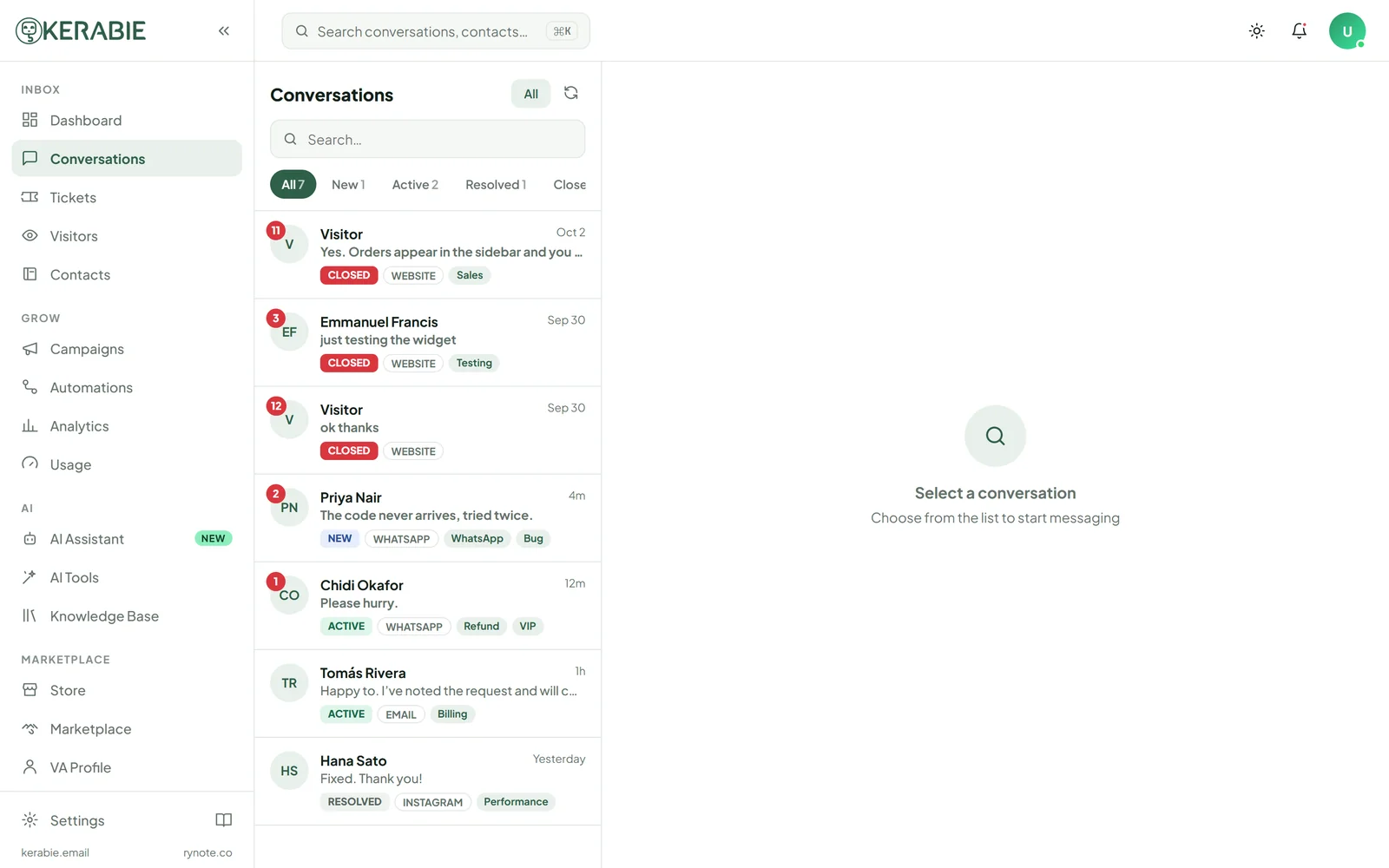
Kerabie implements this hybrid by default — AI answers first, agents step in seamlessly.
chatbotlive chatAIcustomer support